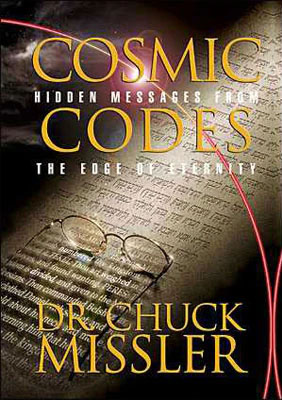
A new book by Michael Drosnin, The Bible Code, has stirred up further controversies about "codes" in the Bible. Very effectively promoted by Simon and Schuster, and including extremely aggressive claims by the author, the book has become a major topic of conversation and a source of more "millennium mania," as the press likes to characterize the more bizarre topics emerging as the year 2000 approaches. Warner Bros. has reportedly picked up the movie rights.
The discovery of ostensibly "hidden" messages occurring among equally spaced letters ("equidistant letter sequences" or ELS) in the Biblical text has been discussed in a number of our previous publications.1
Originally observed by Rabbeynu Bachayah in the 14th century, and explored manually by Michael Dov Weissmandl over 50 years ago, the advent of computerized text has recently made these the subject of a number of professional articles in recognized mathematical publications.
A paper was published in 1988 in the scholarly Journal of the Royal Statistical Society, entitled "Equidistant Letter Sequences in the Book of Genesis." In 1994 Israeli mathematicians Eliyahu Rips, Doron Witztum, and Yoav Rosenberg published some landmark articles in the journal Statistical Science that started the current craze.
Drosnin's book suffers from the embarrassment that, although he presents Eliyahu Rips as the "discoverer" of the codes, Rips has disavowed him and has distanced himself from the book.
Where Drosnin seems to derail himself is in his attempt to present-chillingly-fanciful claims to predicting the future. His colorful exploitation of the assassination of Yitzhak Rabin is a variation on a (now) well-known theme.2
For those of you desiring to look into this more substantively, we recommend Grant Jeffrey's book, The Signature of God, or his double-video by the same name. Grant does a good job putting these remarkable discoveries in better balance-testifying to the evidence of design in the Word of God, but not trying to exploit them in foretelling the future, etc.
Other Examples
There are a number of other incredible discoveries of hidden designs in the Biblical text. Our exploration of the genealogy of Noah in Genesis 5 should be well-known to our readers.3 The remarkable acrostics on the names of God in the Book of Esther are also well known in the Talmudic literature.4
Also remarkable are the discoveries of Ivan Panin who, without the aid of a computer, spent 50 years and 43,000 handwritten pages of calculations, to give us his incredible discoveries.5 Perhaps less well known, except to serious students of cryptography, are the encryptions hidden in the texts of both Isaiah and Jeremiah.6
All of these discoveries should bring us to a reverent awe as we continue to explore the Word of God. But we must be careful not to fall into the trap of attempting to exploit the Biblical text as some kind of mystical "Ouija board" in an attempt to predict the future. This misses the point and violates the injunctions of God.7
While we do, indeed, stand in amazement as we discover God's handiwork in the design of the text, and we marvel as we discover that when a thing comes to pass, He had declared the "end from the beginning," we need to focus our attention on the straightforward disclosures aided by the Holy Spirit.
Mark Twain said it well: "It's not the parts of the Bible I don't understand that bother me. It's the parts that I do understand that disturb me."
Even Time magazine closed its review suggesting that "believers seeking divine enlightenment may not want to substitute code for prayer just yet."8
Indeed! Praise His Holy Name!
Notes:
- Personal UPDATE, May 1993, p.5-8; Feasts of Israel, p.9-11; Expositional Commentary of Matthew, vol 1, p.64. See our briefing package, The Bible: An Extraterrestrial Message, for further discussion.
- Personal UPDATE, January 1996, p.4-5; Sovereignty of Man, p.3-6.
- Personal UPDATE, February 1996, p.19-23; Footprints of the Messiah, p.3; Flood of Noah, p.2; The Christmas Story, p.13-14; Countdown to Eternity, p.103-106.
- Personal UPDATE, March 1996, p.5-9; Beyond Coincidence, p.15-21.
- Personal UPDATE, February 1995, p.12-15; Also, our Expositional Commentary on Matthew, vol 3., p.47-54.
- Discussed in our Expositional Commentary on Isaiah, vol 1, p.15-16; from David Kahn, The Code Breakers: the Story of Secret Writing, Macmillan, New York, 1967.
- Deut. 18:10; Jer 14:14; Ezek 13:6, 7; Ezek 21:21-23.
- Time, June 9, 1997, p.56.