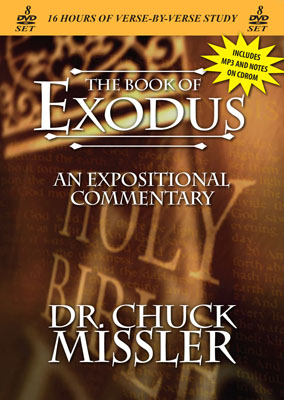
The second book of the Torah, or Pentateuch, is one of the basic "seed-plots" of the Bible. It is basic, dramatic, and provides an essential background for all that follows.
It centers on the call of Moses, one of the most pivotal men of all history and a participant at the Transfiguration.1 We also suspect that he will reappear as one of the Two Witnesses of Revelation 11.
The family of Jacob ("Israel"), who had migrated to Egypt in the Book of Genesis, now emerges as a nation, earning its title as God's "Firstborn."
(It is this designation that is deliberately contrasted with the subsequent death of Egypt's firstborn when Moses is called out of Midian.2)
A Non-Egyptian Pharaoh?
Much has been speculated about the specific Pharaoh in this book. Stephen gives us a clue when he notes that, "Another king arose who knew not Joseph."3 The Greek term used was ἕτερος, heteros, another of a different kind, not ἄλλος, allos, another of the same kind. This Pharaoh was of a different race and dynasty. (Josephus also makes mention of this fact, who describes "the crown being come to another family.")4 It seems that he was the Assyrian of Isaiah 52:4.
No wonder he became uncomfortable with the continuing growth of a non-Egyptian constituency in Goshen!5
The plight of Israel under the taskmasters leads to the famed Passover and the deliverance of God's chosen people.
The celebration of the Passover continues as one of their principal observances to this day. In fact, the instruction to the nation was to make this month (Nisan) "the beginning of months." Thus, Israel has two calendars; one, their civil calendar, begins in the fall (Tishri, about September/October on our calendar); the other, their religious calendar, begins in the spring (Nisan, about April/May on our calendar.)
It is interesting that John the Baptist's first public introduction of Jesus declared, "Behold the Lamb of God that taketh away the sin of the world."6 This was an allusion to the Passover Lamb. Paul reminds us that all these things were also "a shadow of things to come."7
It is also astonishing to discover that the "new beginning" of the Planet Earth after the flood of Noah occurred on the anniversary-in advance-of our "new beginning" in Christ, on the 17th of Nisan, the 7th month of the old calendar.8
The House of Blood
When Moses came down from Mt. Sinai, he not only carried the famed Ten Commandments; he also brought with him the detailed specifications of a portable sanctuary that would accompany the nation until replaced by Solomon's Temple.
A careful study of this "Tabernacle" reveals amazing mystical discoveries, each pointing to the Messiah. (A detailed study of this mysterious structure is essential for every serious student of the Bible.)
The Book of Exodus is an adventure of discovery, since the dramatic narrative is laced with numerous hidden messages in the form of microcodes and macrocodes, each anticipating the New Testament climax.
In addition to Moses himself and the hidden symbolism of the Burning Bush, the Tabernacle structure, and its observances, we also encounter the strange manna, the role of the two rocks,9 the numerous elements of the priesthood, et al.
The Book of Exodus is the bedrock of God's plan of redemption and is one of the most rewarding studies in the Old Testament.
Notes:
- Matthew 17:3.
- Exodus 4:22-23.
- Acts 7:18.
- Antiquities ii, 9.
- Exodus 1:9, 10.
- John 1:29.
- Colossians 2:17.
- Genesis 8:4. Crucified on the 14th + 3 days in the tomb = 17th.
- 1 Corinthians 10:4.