In the late 19th century, Charles B. Huleatt, an Egyptologist, acquired three small fragments of papyrus that were unearthed in Upper Egypt and subsequently bequeathed them to his Alma Mater, Magdalen College, Oxford, in 1901.
These three segments contain the Greek text of Matthew's Gospel, Chapter 26, verses 23 and 31. There are a total of 24 lines, text on both sides. (This implies that they were part of a codex-a book with pages rather than a traditional scroll, which was written on the smooth side only. These were beginning to make their appearance during the Gospel period. In his final letter, Paul requested Timothy to bring his notebooks to him.1)
In 1953, Colin H. Roberts, a notable British papyrologist, declared that these papyrus fragments were probably from the late second century A.D. It would be 40 years later that advanced technology would reveal that these three small fragments are apparently the oldest New Testament manuscripts in existence, contemporaneous with the Apostles themselves and other eye witnesses!
In 1994, Dr. Carsten Peter Thiede, Director of the Institute of Basic Epistemological Research in Paderborn, Germany, used a scanning laser microscope to more carefully examine these fragments, "P.Magdalen Greek 17/P64," as they are formally designated.
A scanning laser microscope can now differentiate between the twenty micrometer (millionth of a meter) layers of papyrus, measuring the height and depth of the ink, and can even determine the angle of the stylus used by the scribe. Dr. Thiede compared the fragments with four other known references: a manuscript from Qumran, dated to 58 A.D.; one from the Herculaneum, dated prior to 79 A.D.; one from Masada, dated between 73-74 A.D.; and one from the Egyptian town of Oxyrynchus, dated 65-66 A.D. He astounded the scholastic world by concluding that the Magdalen fragments were either an original from Matthew's Gospel, or an immediate copy, written while Matthew and the other disciples and other eye witnesses were still alive! Matthew's skills in shorthand (an essential requirement for a customs official in a society devoid of printing, copiers, and the like) are evident in his inclusion of the extensive discourses, which he apparently was able to record verbatim!
The Magdalen papyrus discovery is distinctive in that it was dated on the basis of physical evidence rather than a literary theory or historical suppositions. This is just an example of how advanced technology can reveal discoveries in existing artifacts.
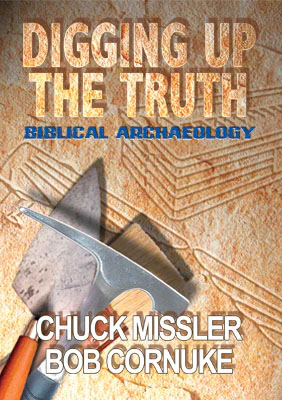
Other technologies discussed in our currently featured Briefing Pack, Digging Up the Truth, a review of Biblical archaeology by Chuck Missler and Bob Cornuke, include ground-penetrating radar,2 microgravity sensors, and thermographic (infrared) scanning3 , as well as laser microscopy. Bob discusses some of the amazing adventures he has had with the discovery of Jabel al Lawz, which appears to be the real Mt. Sinai in Arabia,4 and other recent discoveries. His clandestine penetration of forbidden areas, eluding armed patrols, etc., and the astonishing discoveries encountered are gripping. [Our article on "Nehustan" in this issue also highlights some of the dangers that can accompany the excessive veneration of artifacts, however authentic they may be.]
Notes:
- 2 Timothy 4:13.
- Chuck had the opportunity to participate with Lambert Dolphin, Director of the Radio Physics Laboratory of SRI International in Palo Alto, in introducing this technology to the archaeological community in Israel in 1981.
- Thermographic (infrared) scanning can be effective in determining underlying structures, particularly in restrictive conditions, such as the Temple Mount in Jerusalem.
- Galatians 4:25.
Source:
Thiede, Carsten Peter & D'Ancona, Matthew, The Jesus Papyrus, Weidenfeld & Nicolson, London, 1996.