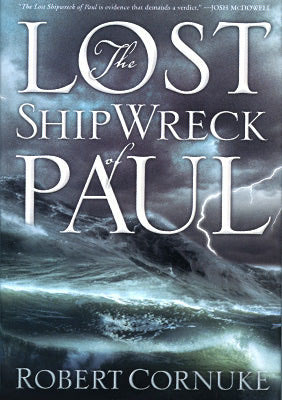
Over the past year and a half, BASE Institute has been involved in painstaking research into Luke's amazingly detailed account of Paul's voyage and shipwreck off the coast of Malta, as recorded in Acts 27.
From the very beginning, I have felt that with enough research, Biblical investigation, and on-site observation, we would stand a good chance of finding what no one to date has been able to find - the precise location of Paul's shipwreck along the coast of Malta.
Like many other traditions relating to Biblical events, there is a traditionally held site for the location of Paul's shipwreck. This place is on the island of Malta in a body of water called "St. Paul's Bay," a tradition started by a priest in the 1500s but not supported in any way by historical evidence.
The Bible, however, places the location of Paul's shipwreck in a different area than the traditional site. As other research efforts of the BASE Institute have proven in the past, Bible history and tradition are often completely opposite from one another. As it turns out, Luke's careful record of the voyage and shipwreck argue convincingly against the traditional "St. Paul's Bay," where no artifacts have ever been found, though professionals have searched for them.
As I began to investigate Luke's account more carefully, one detail kept jumping off the pages of Scripture at me: after all the horror and travail of the storm at sea, and the ship's narrow escape by putting out four stern anchors in the middle of the night, the next morning ". . . casting off the anchors, they left them in the sea . . ." (Acts 27:40). A quick check of the original language let me know that the sailors did, indeed, cut loose the four anchors and did not bring them on board. And research into sailing ships of the day informed me that the anchors in question would have been huge, lead-and-wooden Roman-style anchors common on huge freighters like the one Paul sailed on.
As I correlated all these facts, I realized that the four stern anchors of Paul's prisoner-laden cargo ship may well represent the best possibility in the world today of recovering an actual, physical object specifically mentioned in the pages of the Bible. Spurred on by the potential impact such a discovery could have on the issue of the Bible's historical accuracy, we at BASE drew on as many experts as possible in analyzing all the weather patterns, maritime lore, sailing equipment and techniques, and details in Luke's account that could possibly lead us to the real wreck site of Paul's voyage - and, hopefully, to the massive lead anchor stocks I believed must be in the sea off one particular bay along the Maltese coast, just as Luke described it.
As more and more facts emerged from our investigation, the possible search areas became fewer and fewer, until by the time our search team made our most recent trip to Malta, we had narrowed down our target sites to just two relatively small areas.
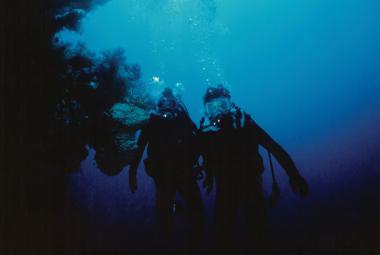
Once on-site in Malta, our multiplied hours of research really began to pay off. Through an amazing series of "coincidences" on Malta, we located, interviewed, and went diving on-site with a local spear fisherman who several years ago stumbled across four lead anchor stocks in the precise location, and at the precise depth, our research had already predicted. Even more amazing, because he had no idea what he had found, the diver passed along one of the anchor stocks to a friend of the family - who now kept it on display in her local villa!
Having confirmed Luke's precise details of the anchors' location - a "bay with a beach" (v. 39), a place where "two seas meet" (v. 41), the depth of "fifteen fathoms" (v. 28) - we then secured permission to examine the anchor stock itself. What we found was a classic first-century Roman anchor, as used on Alexandrian ships sailing on official Roman business in Paul's day. Then, with detailed photographs and videotapes in hand, we consulted a scholar from the local university, who confirmed what we already knew. The evidence we had personally discovered fit every detail of Luke's description of the anchors Paul's ship left in the sea.
Excitedly but deliberately, we took inventory. What had our expedition yielded? We had an impartial eyewitness to the existence of four Roman anchors in a location precisely matching the Bible's description. We had instrument readings showing they were left in the sea at the precise depth recorded by Luke. We had a shoreline matching every detail of the eyewitness account in Acts 27, including a bay with a beach, a location where "two seas meet," and a sloping reef between the anchor site and the shore. And - most important of all - we had photos and videotape of a physical, verifiable artifact which, with all reasonable certainty, we could identify as having been specifically mentioned in Scripture!
How had all this come about? Not by the cleverness of any individual, and certainly not by assuming that the Bible cannot be trusted. Rather, it had come about by taking the Bible at face value, using it as a "road map" to guide our research, and then stepping out in faith and putting its details to the test in a tangible way. As always, the Bible proved itself reliable and historically accurate.
There is much yet to do at Malta. In cooperation with the Maltese government, we want to return and do much more to verify the identity of the Roman anchor stock now at rest on the island. We are in the process of seeking the resources to move our search closer to shore from the anchor site in order to seek out verifiable artifacts from the shipwreck itself. And, again based on the Luke's description in Acts, we believe we may have located the ruins of the inland Roman- style villa of Publius and his father, mentioned in Acts 28:7-8, which we would like to investigate further under Maltese oversight.
Most important, we want to continue documenting evidence of the Bible's reliability so that we can put into the hands of "everyday" Christians quality materials that will not only boost their confidence in the Bible, but provide them with tools for effectively leading others to Christ and building up Christians in their faith.
[Bob Cornuke can be contacted at the Biblical Archaeology Search & Exploration (BASE) Institute: www.baseinstitute.org.]