It is often startling to discover how relevant the Book of Psalms is to our contemporary world today!
Psalms 120 - 134 comprise a group known as “The Songs of Ascent,” traditionally sung on one of the three required pilgrimages to Jerusalem.1 The first of these is an astonishing psalm, conspicuously appropriate to the front pages of today’s newspaper! Let’s take a quick look at this brief psalm:
[A Song of degrees.] In my distress I cried unto the LORD, and he heard me. Deliver my soul, O LORD, from lying lips, and from a deceitful tongue. What shall be given unto thee? or what shall be done unto thee, thou false tongue? Sharp arrows of the mighty, with coals of juniper.
It appears that this Hebrew traveler, on one of his annual pilgrimages to Jerusalem, comes from a tough neighborhood, characterized by deceitful tongues.
What does his distress cry plead for? “...the sharp arrows of the mighty [man], with coals of juniper.” (Juniper roots are ideal for charcoal: they yield the hottest and most-enduring fire.)
This is an “imprecatory psalm”: one crying out for vengeance. Where does he live? Where is he coming from?
Woe is me, that I sojourn in Mesech, that I dwell in the tents of Kedar!
Unless you know your Bible, you may miss the import of this disclosure! First of all, who was Meshech? He was a grandson of Noah (see following chart):
That is, a son of Japheth, a Gentile.
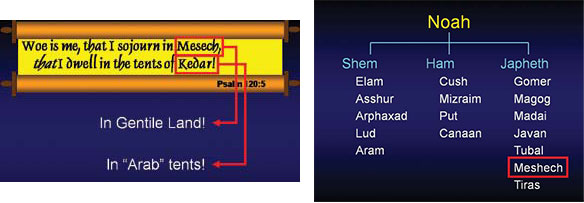
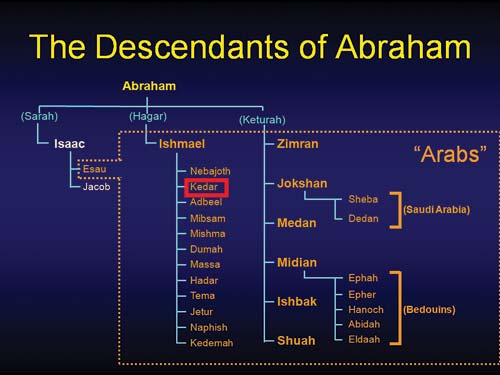
Who was Kedar? He was a son of Abraham, but not Jewish. This will require a closer look at his background (and a glimpse through the fog that clouds the perspectives of the news media).
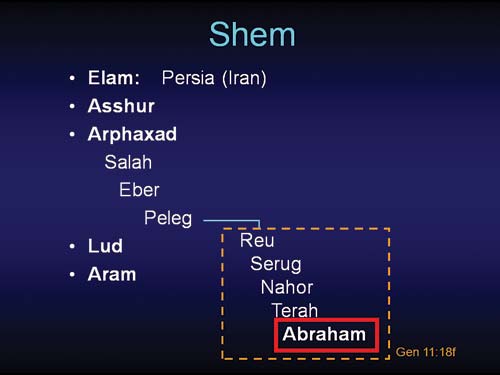
Abraham was a descendant of Shem (below): Kedar was a descendant of Ishmael, the son of Hagar, the Egyptian.
Arabian tribes were descended from the concubine Keturah. However, it is also important to realize that Esau, Jacob’s brother, in a deliberate effort to offend his parents, took Ishmaelite wives, including Nebajoth’s sister. His descendants, Ishmael’s, and Keturah’s all intermarried; no tribal distinctions were required to be maintained. So the term “Arab,” as is commonly used in the news media, is somewhat indistinct and very broadly employed.
(What links these diverse groups referred to as Arabs in the media is not their genealogy, but their religion: they are united by a legacy of hatred. They are Muslim. The two houses of Islam, Sunni and Shi’ite, hate each other almost as much as they hate Israel.)
So with this background, we gain a more revealing insight into the plight of the pilgrim. This paradox is further amplified in the pilgrim’s plea for peace:
My soul hath long dwelt with him that hateth peace. I am for peace: but when I speak, they are for war.
Doesn’t that characterize the current tensions in the Middle East? The enemies of Israel are resolute in their denial of Israel’s right to even exist. Nine times it was the “Palestinians” that walked away from the negotiating table, insisting on an “all or nothing” resolution to the proposals on the table. We know from Zechariah’s resonant prophecy2 that the entire world is destined to go to war over the issue of Jerusalem. Clearly, there will be no peace until the Prince of Peace comes to enforce it.
But, as you examine Psalm 120 and attempt to apply the exegetical principles of “higher criticism,” this certainly could not have been written back then; it must have been added in more recent times! …Or, are the fingerprints of the Holy Spirit clearly evident in this psalm? It’s your call.
The Book of Psalms is a treasure trove of prophetic discoveries and insights.
Notes:
- Deuteronomy 16:16.
- Zechariah 12:2-3.