Do you have “faith” in the chair you’re sitting on? Why are you confident it will hold your weight? It may seem solid enough, but suppose I told you that essentially there was nothing there?
The molecules of the materials that make up the chair you’re sitting on are collections of atoms (which, of course, we’ve never seen since they are smaller than a wave length of light). Yet, let’s try to comprehend the substance of what we are talking about.
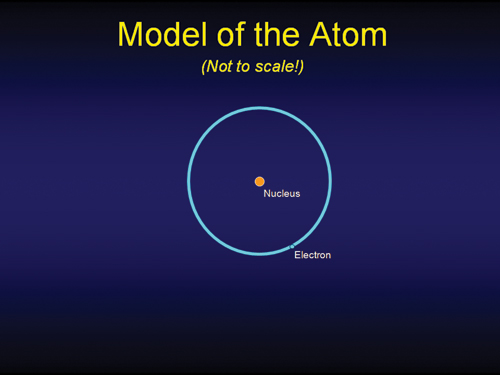
The simplest atom is that of hydrogen, which can be visualized as a nucleus (of one proton) encircled by a single electron.
This sketch is, of course, not to scale. It is useful, however, for us to attempt to gain an appreciation for the relative sizes involved.
The hydrogen atom is approximately 0.00000001 centimeters in diameter, usually abbreviated as 10-8 cm. The nucleus, consisting if a single proton, is approximately .0000000000001 centimeters in diameter, usually abbreviated as 10-13 cm. In linear terms, that’s a ratio of 10-8/10-13 which is 105, or 100,000 times!
That may be a bit too abstract for most of us. Let’s try to picture making a “model” of this. Let’s take a golf ball to represent the nucleus; our “electron” would have to be over a mile, or 55 football fields, away!
But that’s just the linear differential. To represent this volumetrically, (length x width x height), we need (105)3 or 1015, a numerical relationship which is virtually impossible for us to grasp! It is the same relationship that one second has to 30 million years!
So, as I confidently trust that my chair will hold my weight, and yet you might insist that there really “isn’t anything there,” you would be closer to the real reality by that same physical relationship: the ratio of 30 million years to a mere second!
As atoms bond to other atoms to make up a molecule, it is the electrical relationships that create the ostensible solidity (or liquidity) that we sense in the apparent reality around us. That is precisely what the Bible has said all along:
Through faith we understand that the worlds were framed by the word of God, so that things which are seen were not made of things which do appear.
Hebrews 11:3
As we further explore the nature of the tiny particles that create the illusion of our reality, it gets worse.
Our Finite Universe
The great discovery of the 20th century was that our universe is finite. That’s what has led to the various conjectures of its beginning: the so-called “Big Bang” speculations: “First there was nothing; then, it exploded.”
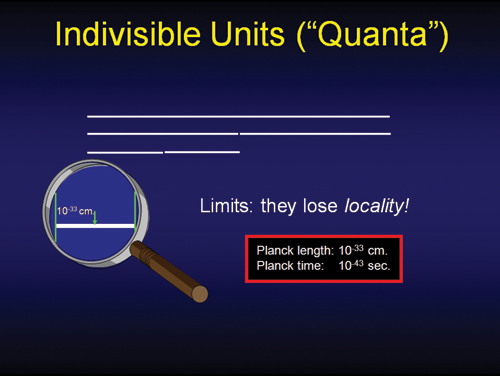
But that only attempts to deal with the “finite-ness” on the large end of things: the macrocosm. The attempts to explore “finite-ness” on the small end of things-the microcosm-results in even more strangeness. Again, let’s attempt a simple illustration.
If we take any length, we can divide it in half. We could retain the half, and divide it again, discarding the remainder. We take the remaining half, and divide it again, discarding the remainder. We naturally assume that we could-at least conceptually-do this forever, dividing ever smaller remainders, etc. However, we would discover that when we reach a defining minimum-the “Planck length”-any attempts to divide the remainder results in “non-locality”: being everywhere at once!
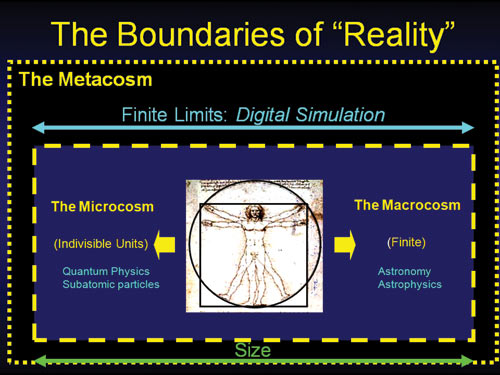
It has been proven that all “non-local” particles throughout our apparent universe are somehow intimately connected simultaneously: negligible “travel time” is involved!
Everything we encounter: length, mass, time, energy-are all composed of indivisible units, commonly called “quanta.” This field of study is called “Quantum Physics” and its philosophical implications can be shattering to our presuppositions about our “reality.” We now discover that the reality that surrounds us is a virtual reality-in fact, a digital electrical simulation!
Scientists are now beginning to suspect that our universe is but a “shadow” of a larger reality.1 That’s what the Bible has said all along! For deeper study, see our briefing, Technology and the Bible.
Notes:
- Barrow, John D. and Webb, John K., “Inconstant Constants,” Scientific American, June 2005, page 57.