The Epistle to the Hebrews is one of the two greatest theological treatises of the New Testament.1 This letter is, in a real sense, the “Leviticus” of the New Testament, detailing how the Lord Jesus Christ is both the fulfillment and the successor to all that had gone on before.
The extreme dilemma of the Jewish Christians—especially while the Temple was still standing—was their extreme predicament. They had been drawn from a divinely appointed religion, with divinely appointed priests officiating in a divinely appointed Temple, accomplishing a divinely ordered service, all of which had been ennobled throughout their entire history.
How could believing priests and Pharisees remain “zealous of the Law”? This letter was clearly aimed at the people who were now Christians but had come out of Judaism. It focuses on the background that they came from, and tries to demonstrate how Jesus was a fulfillment of those things; in fact, he superseded those things. Jesus is the very fulfillment of the Old Testament.
The author of Hebrews had three main objectives: 1) Combat possible apostasy (Heb 2:1-4; 10:19-25); 2) Encourage them to press on to spiritual maturity (Heb 5:11-14; 10:32-39); and, 3) Comfort them in their persecutions (Heb 11:1-12:3). His method was to highlight the superiority of the Messiah to the three pillars of Judaism: angels, Moses, and the Levitical priesthood. The contrasts were not between bad and good (both are from God); but between good and better. He deviates from his logical arguments to include five major warnings—which offer some interesting insights.
Authorship
Who wrote the book of Hebrews? Hebrews is an unsigned book and there are many theories, but the available evidence, we feel, seems to justify a Pauline ascription.
Apollos? Some suggest that Apollos wrote this epistle, although there is not much evidence to support the theory. Furthermore, Apollos was from Alexandria, and yet even in Alexandria in the earliest times the book was associated with Paul. So, if Apollos was the author, somehow he didn’t even convince his own hometown.
Barnabas? Others ascribe the book to Barnabas, but here again there is no evidence to support this theory. There are some spurious writings (that are not regarded as authentic) that were attributed to Barnabas, but their style is so different from the Epistle to the Hebrews that if one can conclude that the writings attributed to Barnabas were at all indicative of Barnabas’ style, he clearly didn’t write the Epistle to the Hebrews.
Paul? There are many stylistic reasons that point to its Pauline authorship.
Paul’s Special Mark
If one recognizes that there were apparently forgeries of Thessalonian letters being circulated, then several passages become clearer.2 Thus at the end of that letter, Paul includes a sort of special mark, a token:
The salutation of Paul with mine own hand, which is the token in every epistle: so I write.
2 Thessalonians 3:17
Note how Paul is emphasizing that he has signed the letter with his own hand (most were probably drafted by an amanuensis or secretary). He would include a sign at the end so they would know that the letter was really from him.
So what is this signature or style item that is included in every letter?3 The grace of our Lord Jesus Christ be with you all. Amen (2 Thess 3:18). And how does Hebrews end? Grace be with you all. Amen (Heb 13:25). Why is this so impressive of Paul’s style? Because the word “Grace” does not even appear in the other epistles!4
The Trilogy on Habakkuk 2:4
The key verse in Habakkuk is: The Just shall live by faith (Hab 2:4). This verse became the primary banner that inflamed the Reformation. It would seem that Paul penned a deliberate trilogy on this very verse:
Who are “The Just”? The Book of Romans answers the question (Cf. Rom 1:17). How then “Shall [they] Live”? Galatians shows how we are to live—called out of religious externalism (Cf. Gal 3:11).
“By faith...” What is the epistle on “faith”? This Epistle to the Hebrews (Cf. Heb 10:38)!
As a former systems engineer and technologist in the information sciences, I tend to favor evidences that reveal an architecture and integrity of design, and it is this unique characteristic of the entire Bible that has been the foundation of our ministry.
Thus, it is the apparent trilogy of Romans, Galatians and Hebrews, dealing specifically with Habakkuk 2:4, that causes us to lean strongly on the inference that Hebrews was authored by Paul. (If it should turn out that it was by another, then this very design becomes an even more impressive “fingerprint” of the Holy Spirit!)
Other Stylistic Evidences
In Romans 8:35-39, Paul lists a number of things that can't separate you from the love of Christ. He lists seven things, and then 10 more, for a total of 17.
In Hebrews 12:18-24 we find a similar list: Again there are seven things, and then 10 more, for a total of 17. And in Galatians 5:19-21 there is also a list of 17 things. (Again, it is Romans, Galatians, and Hebrews that evidence a similarity of style.)
Paul also favored the Greek word, uio,j huios, “sons,” rather than a similar Greek word, te,knon teknon, which other writers use, which means “children.” The “witness of the Holy Spirit,” discussed in Romans 8:16 and Hebrews 10:15 also hints at a common authorship. And in Hebrews 13:18, the writer says, “Pray for us.” There is only one epistle writer that makes that specific request: none other than Paul.
The Role of Timothy
In Chapter 13 of Hebrews, there is a reference that notes that the writer of the Epistle to the Hebrews was accompanied by Timothy.5 We know from a number of epistles that Timothy accompanied Paul.6 We do not have any record of him accompanying anyone else. While that does not mean that Timothy exclusively accompanied Paul, we do not have any evidence of him accompanying any other writer.
Why Anonymous?
So if Paul did write the book, why would he keep it anonymous? From Acts 9:15 we know that Paul was the apostle to the Gentiles. While the Gentiles were his primary mission field, he also had an intense burden for his own brethren. Looking at Paul’s life, it is clear that Paul would sooner or later write an epistle to the Hebrews.
So why would he write one and keep it anonymous? Because every time he tried to address them there were riots. He never recovered the confidence of the Jewish side; they reputed his apostleship and also feared his attack against their ancient rituals and ceremonies.7
Nowhere in the book of Hebrews does Paul assert his apostleship, unlike his other epistles, but instead he builds his entire thesis uniquely from basic Jewish arguments from Old Testament passages. He exalts Christ, not his own apostleship.
There are reasons in the text that we could infer that the book was probably written after Paul’s first imprisonment, but before his second arrest.8 It was clearly written prior to the destruction of the Temple in 70 A.D. The impending destruction of the Temple may have been one of the reasons that God had Paul show them how they needed, as Christian believers, not only to accept Christ, but to come out of Judaism.9
Peter’s Testimony
Peter also seems to allude to this letter in 2 Peter 3:15-16:
And account that the long suffering of our Lord is salvation; even as our beloved brother Paul also according to the wisdom given unto him hath written unto you...
2 Peter 3:15
Peter here ascribes a letter written by Paul to the Hebrews. But the other 13 Pauline epistles all went to Gentile churches. So if Hebrews was not written by Paul, then there is a missing letter written by Paul to the Hebrews.
As also in all his epistles, speaking in them of these things; in which are some things hard to be understood, which they that are unlearned and unstable wrest, as they do also the other scriptures, unto their own destruction.
2 Peter 3:16
Here Peter is commenting on Paul’s letter, saying that Paul had written some things that were hard to understand (indeed, the difficulties in Hebrews 6 and 10).
Pressing On To Maturity
The primary focus of this letter to believers is to press on to spiritual maturity.10 For anyone serious about their spiritual growth, both the Epistle to the Romans and the Epistle to the Hebrews are absolutely essential to thoroughly understand. Is there any priority or commitment that is more important—or urgent—in your own life? Pray about it.
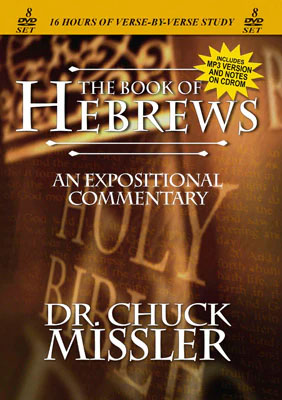
Chuck’s updated study on the Book of Hebrews is available from our store.
Notes:
The other most essential is, of course, the Book of Romans.
Thess 2:2.
Rom 16:24; 1 Cor 16:23-24; 2 Cor 13:14; Gal 6:18; Eph 6:24; Phil 4:23; Col 4:18; 1 Thess 5:28; 2 Thess 3:18; 1 Tim 6:21; 2 Tim 4:22; Titus 3:15; Philemon 25.
Except in 2 Peter 3:18, where it is used as an instruction or exhortation and not as a salutation or blessing as here.
Heb 13:23, 25.
2 Cor 1:1; Col. 1:1 and 1 Thess 1:1.
Acts 21:27-28; 22:17-22.
Heb 13:23).
Cf. 1 Cor 9:20; Acts 9:15.
Heb 5:11-14; 10:32-39.