We see a vacuous Christianity across our landscape. We see a God without wrath, who would bring human beings into a kingdom without judgment, through the ministry of a Christ without a cross. The truth is not about what is nice or pretty. We need to be about the truth, even when it’s hard to hear.
Jesus warned about false teachers. Jude describes them:
Woe unto them! for they have gone in the way of Cain, and ran greedily after the error of Balaam for reward, and perished in the gainsaying of Core. These are spots in your feasts of charity, when they feast with you, feeding themselves without fear: clouds they are without water, carried about of winds; trees whose fruit withereth, without fruit, twice dead, plucked up by the roots;
Raging waves of the sea, foaming out their own shame; wandering stars, to whom is reserved the blackness of darkness forever.
Jude 1:11-13
This is a grim description of false teachers, yet we encounter them across the landscape. How do we recognize them? By knowing the Bible. Paul warned us:
But though we, or an angel from heaven, preach any other gospel unto you than that which we have preached unto you, let him be accursed.
Galatians 1:8
Don’t be surprised if there’s false teaching in this world - even in the churches. Don’t be surprised if there are traditions that are in error bandying about us. We use these heresies to wrestle through and discern what is true. How? By doing our own homework.
Starting the Journey
We often forget that God is not on trial. We are. He is God. He doesn’t answer to us. We answer to Him, and we are the ones who face trials and temptations. How do we therefore get started? How do we enjoy our Bibles? I think that if it’s not fun, there’s something wrong. I’ve had a lifetime of adventures, but the most exciting adventures of all are those I’ve made in the Scripture.
As we seek to begin our study of the Bible, a number of questions
come up:
- What is the best approach to Bible study?
- Which is the best Bible translation?
- Which is the best study Bible?
- How do we resolve controversial passages?
Let’s start with the first question.
Bible Study Approaches
The verse by verse study takes a straight path through a Bible book, reading the book from beginning to end and gathering knowledge about each verse or passage along the way. This is an excellent way to learn what the entire Word of God says, and you’ll find that you see something new with each read. It takes time to read through the entire Bible, especially while stopping to understand specific verses and their context.
The topical Bible study, as the label implies, focuses on a specific subject. For instance, we might take baptism or pride or the spiritual gifts and research the Scriptures about that specific topic. There is a place for topical Bible study, and it’s a good way to get a solid grasp of a particular issue that’s of interest to us. We can hunt down all the verses in the Bible that deal with baptism or pride or the spiritual gifts and get the “whole counsel of God” on the matter.
Topical studies are great, but it’s important to have a strategic grasp of the whole Bible first. If we only do topical studies, it’s easy to leave large holes in our knowledge, and that can leave us vulnerable to deceptive ideas.
The word study can take advantage of modern computers, which make it easy to pick a word and find every place it’s used in the Bible.
We find some words are used repeatedly to convey a specific theme. It’s interesting to notice every place the Bible uses the words “horn” or “rock,” for instance. It’s informative to see which passages refer to God as the “LORD of Hosts” or all the Old Testament prophecies about
the “branch.”
Some people study the dispensations of the Bible, that is, how God dealt with people in different times throughout history. They seek to understand the predicaments each different group of people faced and what God asked of them.
Others choose to read the Bible according to specific doctrines. There’s a place for studying the doctrines of the Bible and developing them as teaching tools. There is a lot in the Bible about justification by grace through faith, for instance. There is also quite a bit about the deity of Christ, sanctification by the Holy Spirit, God’s omniscience and so forth. It’s important to know why we believe what we say we believe. It’s important to read all the verses on a subject and get a balanced view, because some denominations develop doctrines from just a verse or two while ignoring the rest of the verses that give us a more complete view of the situation.
I am going to pick on certain Pentecostal denominations, for instance, which teach that speaking in tongues is the evidence for being filled with the Holy Spirit. We certainly find many occasions in Acts when people were filled with the Holy Spirit and then began speaking in tongues. In those cases, speaking in tongues was absolutely evidence of being filled with the Holy Spirit. However, some denominations have taken these passages further than the Bible takes them, and they have taught that anybody who is filled with the Holy Spirit will speak in tongues.
This is blatantly adding to God’s words, because the Bible doesn’t teach any such thing. In fact, Paul spends 1 Corinthians 12-14 explaining that the Holy Spirit gives different people different gifts, and there is no one gift given to everybody. What’s more, he presents speaking in tongues as one of the lesser gifts and prophecy as one of the more important gifts. Paul reminds his readers, however, that love is more vital than any gift, and without love we are just making noise.
This is why I will hammer over and over again about the importance of knowing the whole Bible. It takes time, but in our doctrinal studies, we need to make sure to have a grasp of all the Bible says on a subject and not make our favorite verses mean more than they do. It’s easy to do, and it’s also why I encourage people not to believe anything just because I say it - or just because another Bible teacher says it. It’s important to study the Bible yourself, because we teachers are fallible.
There are yet other types of Bible study. We might make a biographic study and study the life of Paul or Peter or James. We might make an analytical study and spend hours trying to figure out what a verse really means. This gets academic, but it can be important to do with confusing passages. I am personally a fan of synthetic studies, those that put together the whole thing to gain an understanding God’s big picture.
Pieces of the Big Picture
Many people have never really studied the Bible before. We’ve developed a study called Learn the Bible in 24 Hours - 24 one-hour sessions - that gives people an overview of the entire Bible.
It includes maps and diagrams and helps people learn to navigate their way around the Scriptures. I would recommend starting there, because it offers an overview of each book along with a strategic overview of the whole Bible. Whatever approach you use, the main goal is to develop a strategic grasp of the entire package.
I continually want to emphasize the integrity of the Bible’s design.
After getting that good solid overview of the Bible, I support verse-by-verse expositional study. We’ve done expositional studies on every book of the Bible, some more than once. This is the kind of Bible research that “eats the elephant one bite at a time”, so to speak. In my lifetime of Bible study, I’ve found that expositional studies have lasting results in people’s lives.
I enjoy topical studies and word studies too, but the backbone of Bible study should be expositional reading that takes people through the entire counsel of God. It prevents us from having gaps - from missing important elements of God’s Word. Some denominations focus on doctrinal training and teach people to name “proof” verses that support their doctrines. That’s fine if those doctrines truly represent the whole counsel of God. Too often, however, we find that each denomination has its pet doctrines to the neglect of the whole Word of God. We need to be exposed to the entirety of Scripture.
Jesus emphasized the Scripture. One of the first things He did after the Resurrection was go on a seven-mile Bible study with two of his followers on the road to Emmaus. During those two or so hours, Jesus took them through the books of Moses and the Psalms and the Prophets and showed them all about Himself from the Old Testament. He used the whole counsel of God.
Which Book First?
Once you have a good overview of the Bible, pick an individual book to study. Many people start with Genesis, which is a natural beginning point. It is the book of beginnings. The salvation story starts right there in Genesis. Of course, many people have read through the beginning of Genesis fifteen times without going further. It’s okay to start somewhere else, and we all have different favorites.
I think one good book to start with is the Gospel of John. As the great saint Augustine stated, “The Bible is shallow enough for a child not to drown, yet deep enough for an elephant to swim.”That’s a cute way of saying that the Bible (including the Gospel of John) is straight-forward enough for new believers to work through and learn a great deal. Yet, if you have read through the Bible 100 times, it’s still possible to make additional discoveries with each new venture through John’s Gospel. That’s what we would expect of a book that’s supernatural; it’s inexhaustible.
You might start with Matthew, which is full of Jesus’ discourses. Matthew was a tax collector, and he would have had shorthand skills in that trade. It is possible that Matthew wrote down Jesus’ sermons verbatim. Matthew also paid close attention to the many Old Testament passages that Jesus fulfilled. His is the Gospel that focuses on Jesus as the Lion of Judah, the Son of David,
the Messiah in fulfillment of the Scriptures.
Acts describes the beginning of the Church, while Daniel lays out Gentile history in advance. Daniel and Revelation are closely tied together, and I actually like to start new believers in Revelation. That shocks some people, but I do that because it’s the only book of the Bible that has the audacity to say, “Read me. I’m special.”
Blessed is he that readeth, and they that hear the words of this prophecy, and keep those things which are written therein: for the time is at hand.
Revelation 1:3
The blessing comes from several sources. Revelation offers wisdom and warnings to help us avoid error. One of the most interesting blessings, however, is that Revelation touches on every other book of the Bible. In its 404 verses, Revelation includes more than 800 allusions to the Old Testament. Revelation is also the wrap-up book of the Bible. Everything that started in Genesis is wrapped up in Revelation with a big ribbon.
Remember, however, that each of us is unique. The Holy Spirit knows you and your particular needs. He knows what would be best for you to dive into, and He will lead you. I encourage you to pray about it and let the Spirit guide you. It may be He gives you an interest in one book over the others. The important thing is to take a book, any book, and go through it verse by verse. When you are finished with the first book, go on to another one.
Which Translation
In today’s world of computer technology, it’s not hard to get serious about the Bible. There are a variety of programs and sites that make it easier than ever to reach into the Hebrew and Greek without knowing Hebrew or Greek. Sites like BlueLetterBible.org, biblegateway.com and Biblehub.com offer verses in a range of versions, with the original languages and commentaries readily at one’s finger tips.
People like to ask me which translation they should read. I tell them I finally found the version I like best, and they lean forward eagerly. Then I hold up my Bible and point out that it’s a large print version. Senility is a humbling thing.
I started out with the King James Version. I’ve gone through virtually all of them, and I’ve come back to the King James for a variety of reasons. Every translation from the Hebrew or the Greek to English has problems. Certain idioms and nuances just do not translate from one language to another. The translators had to ask themselves how precise they were going to be and how they would treat figures of speech. Those things raise issues. The good news about the King James Version is the issues are well known and well documented. Several modern versions will “translate” by interpreting a text and giving us their interpretation of what it means. The King James is fairly literal in its translation from the Hebrew and Greek, leaving the interpretation up to us.
The English language has changed a little bit since 1611, and it’s not as easy to read the King James. The New King James attempts to remedy some of the archaic word use, while still giving a fairly straight forward translation. However, I always do my memory work in the King James. It’s a standard, and it has a certain majesty about it.
I was on a Scripture memory kick when the Revised Standard Version came out, and I was well advised to avoid it. It’s fallen into some disrepute. There will be problems with any translation, but we know the issues with the King James. King James study Bibles include footnotes that offer alternative meanings or questions of accuracy. There will be ever new modern translations that will be more modern than the last modern ones. I’m grateful I did my memorization work in a version that will be around fifty years from now.
Textus Receptus
There’s another reason I prefer the King James. The KJV translators used the Textus Receptus as their primary Greek source. There were 5,556 manuscripts available to the King James translators, and they leaned primarily on the Textus Receptus, which had been put together by Erasmus of Rotterdam from Greek texts used by the Byzantine Church. In recent years, it’s been popular for translations of the New Testament to be made based on three older texts from the 4th and 5th centuries. These three codices, Alexandrinus, Vaticanus and Sinaiticus, are called the “Alexandrian codices.” It sounds good to say, “they are older texts.” The problem is that the Alexandrian codices survived since the 4th century because they weren’t used. They are dreadful transcriptions filled with copyist errors, and there are places it appears the scribes doing the copying were exhausted and trying not to fall asleep - or else were terribly sloppy.
A professor of divinity at Oxford, John William Burgon (1813-1888), made a trip to the Vatican to read Vaticanus “Codex B” himself. He also studied Sinaiticus firsthand, and he was not impressed with them at all. Burgon denounces Vaticanus, saying:
It is undeniable … that for the last quarter of a century, it has become the fashion to demand for the readings of Codex B something very like absolute deference. The grounds for this superstitious sentiment, (for really I can describe it in no other way,) I profess myself unable to discover. Codex B comes to us without a history, without recommendation of any kind, except that of its antiquity. It bears traces of careless transcription on every page. The mistakes with the original transcriber made are of perpetual recurrence.1
Burgon blames the many missing verses or half verses in the codex on “oscitancy” - on the dullness of a tired copyist who is yawning more than he is paying attention. Burgon continues:
[I]n the Gospels alone, Codex B leaves out words or whole clauses no less than 1,491 times… accounted for by the proximity of a “like” ending… On the other hand, I can testify to the fact that the codex is disfigured throughout with repetitions. The original scribe is often found to have not only written the same words twice over,
but to have failed whenever he did so to take any notice with his pen of what he had done.”2
We also find that there was a serious problem with Gnosticism in Alexandria in those days. The Gnostics had doctrinal ideas that conflicted with the New Testament writings, and they would delete passages and verses they didn’t like. We go over these issues in depth in our study How We Got Our Bible. As a bottom line, I do not depend much on textual questions that are raised because the Alexandrian codices left out or changed passages. I’m convinced that verses were more like to be removed from the New Testament Greek texts - whether purposely or through weary error - rather than the popular idea that verses were added later.
Bible Memory
Psalm 119:11 says, “Thy word have I hid in mine heart, that I might not sin against thee.” To hide God’s Word in your heart implies that you’re going to memorize some Scripture.
Which Study Bible?
A young lady in our ministry has said that she picks her study Bibles according to their treatment of behemoth in the notes of Job 40:15 and of leviathan in the notes of Job 41:1. If the notes say, “a large animal identity unknown” she is willing to buy the study Bible. However, if the notes claim that behemoth is an elephant or a hippo, if they say that leviathan is a crocodile or a whale, she puts the study Bible back on the shelf.
Why is that her litmus test?
She doesn’t want a study Bible in which the editors’ guesses are presented as fact. She’s correct, of course, because any fanciful attempt to identify behemoth or leviathan with existing animals is ludicrous. The text doesn’t match any creatures alive today. If the editors are willing to suspend judgment about the identities of behemoth and leviathan, she feels she can trust the rest of their footnotes to be simply honest. Calling behemoth a “hippopotamus” or leviathan a “crocodile” is evidence to her that the editors are willing to force their own presuppositions on their textual notes. Since that’s not what she wants, she puts those study Bibles back.
I recommend that you go and look through a variety of study Bibles. Find one you enjoy holding and reading - one that is easy on your eyes, one that is comfortable. Feel free to look at the footnotes and how the editors format them. Try using the Bible’s cross references and see if the verses add to your understanding. Feel free to see what they say about behemoth and leviathan.
In the end, pick a study Bible and wear it out.
Mark it up. Get one with wide margins, put your notes in it, and then outgrow it and pick another one. That’s the challenge.
Three Phases
Phase One: Reading Plan
I suggest a three-phase program for Bible study. The first thing is to have a reading plan that’s different from your study plan.
There are several ways to read the Bible through on a regular basis. You might just sit and read from Genesis to Revelation, a few chapters at a time. I enjoy reading portions of the Old Testament, the New Testament, and the Psalms. When I do this, I use three bookmarks, one for each part of the Bible. Then I move the bookmarks a chapter or two each day. That’s a simple way to go at it.
I travel with eight Bibles, a dozen commentaries, and concordances in Greek and Hebrew in a device I can carry in my pocket. We used to carry books, then PDAs. We now have phones that can access the entire world. I do my more serious study on a laptop, but I can also carry a Bible on my phone. I can have seven bookmarks in my digital Bible, and I happen to have one in the Torah, one in the Historical Books, one in the Poetical Books, one in the Prophets, one in the Gospels, one in the Epistles, one in the book of Revelation. I try, imperfectly by the way, to read a chapter from each section each day. When I arrive 15 minutes early for a barber shop appointment or I’m held up in the doctor’s waiting room, I read one or two of these bookmarks.
In fact, this is a good method for habitually late people to work on in order to be on time wherever they go. Plan to arrive half an hour early, early enough to read a few bookmarks, knowing you will not be wasting the precious moments in your day. At the best, you’ll arrive early and have time to read. If you find you keep arriving just on time, at least you’re not late anymore. If this is the case, though, change your strategy and plan to get places an hour early. You might get in 15-45 minutes of Bible reading.
By reading several bookmarks each day, I can get through the Old Testament once a year and the New Testament twice a year easily. The bookmarks are handy, but many Bibles have ribbons. Find a Bible with a lot of ribbons, if you like. I find the digital Bible handy, neatly held in a cell phone, especially when I travel.
Phase Two: Book Study
The reading plan is the foundation. Next, I encourage you to take on a Bible book study with resources. Go through a chosen book verse-by-verse. First do a background study on your book of interest, whether it’s John or Isaiah or Revelation. Read up on its historical background and context, its author and his purpose for writing it. If there are controversies, research them. There are many scholars who question the traditional authorship and dates for the Bible books. This doesn’t mean they are correct.
It’s important to realize there is a certain bias against supernatural explanations in academia. Therefore, because Daniel accurately prophesies about kingdoms and events that took place long after he died, secular scholars will date the book of Daniel to the 2nd century B.C.
They treat the book as if it were written after those events took place. Don’t worry about those scholars. Learn about the historical context of Daniel according to the Bible. He was one of the Hebrew children taken captive during Nebuchadnezzar’s first siege of Jerusalem in 606 B.C. Twenty years later, Nebuchadnezzar finally destroyed rebellious Jerusalem and the Temple and took a last wave of exiles to Babylon. There they remained until Cyrus the Great gave a decree in 539 B.C. sending them home (as prophesied in Isaiah 44:26-45:6). Understanding the history of the Babylonian captivity is important when reading Daniel.
When you come across scholars who cast doubt on the prophetic power of the Bible or deny its authors, do not fret. There are many sides to each controversy. Generally, if one scholar argues that Daniel didn’t write the Book of Daniel, then there are other scholars who have already done the work to answer those arguments.
I take the position that the internal evidence doesn’t support a late date for Daniel. It actually supports the authorship of somebody living in the royal court during the Babylonian and Persian empires, just as Daniel claims.
For instance, the Aramaic of Daniel is old and doesn’t match the Aramaic of the 2nd century, BC. Kenneth Kitchen offers no precise date for Daniel’s Aramaic, but he states it is consistent with Aramaic written between the 7th and 4th centuries.3 The Persian words used in Daniel are so old they were mistranslated in the Septuagint. Kitchen says of the Persian used in Daniel:
In the LXX versions, some four Persian words are so poorly ‘translated’ that their meanings must have been lost long beforehand; this would argue for a date before the second century BC... The Persian words are Old Persian, not Middle; this indicates no independent borrowing of Persian words into Daniel after c. 300 BC4
Kitchen is being generous. Old Persian is dated between 600 and 300 B.C., and if the meanings of the Persian words had been completely lost by the time of the Septuagint, that suggests they were written long beforehand.
It’s the Greek that really kills the “2nd Century Daniel” view. Daniel has no influence of Greek words, which we’d expect if it were written during the height of the Greek Empire. Alexander the Great conquered Darius III and took Babylon in 331 B.C. Greece ruled the known world for centuries, yet Daniel contains no Greek loan words except three musical instruments. That’s it. There are no Greek idioms. No other Greek terms. We play pianos and violas, but Italy doesn’t rule America. If it did, we’d all use far more Italian on a daily basis. If Greek was the trade language when Daniel was written, it would have contained a variety of Greek loan words.
We also find that Daniel correctly named Belshazzar as king when the young ruler’s existence had been forgotten by the time Herodotus published his Histories in 425 B.C. It was only after J.G. Taylor found the Nabonidus Cylinders in Ur in 1854 that modern scholarship learned Belshazzar was the firstborn son of the often-absent king of Babylon, Nabonidus. All these things point to an early date for Daniel, long before his prophecies came true.
Most importantly, Jesus tells us that Daniel wrote the book that bears his name. Jesus makes several references to him, always with the attitude that Daniel’s book was a book of prophecy.5 If we know that Jesus Christ is God in the flesh, we should have no worries about the authorship of Daniel.
Research the book you are studying. Learn about its historical background, then read through it verse-by-verse. If controversies bother you, wrestle through those questions and find the answers. There’s a place for learning to defend the authority and reliability of the Scriptures. However, the most important thing will always be reading God’s Word itself. We want to focus on God’s voice - not the voice of dry scholastics who may have missed the point. Before anything else, we need to be reading the Word of God and hearing His heart in every passage.
Phase 3: Research Projects
On top of daily reading and book study, you can do special research projects. There might be an occasion to do a topical study or word study. These are ad hoc excursions on top of your base plan. Your base plan is reading it through the Bible on some schedule, whatever works for you. It is also to be involved in a serious verse-by-verse study of one of the books of the Bible. That’s the base plan. Beyond that, there are subjects you might study beyond your reading plan.
As you pursue your verse-by-verse Bible studies, word studies, topical studies and so forth, you will be benefited by the multitude of resources available. Others have done tremendous amounts of work putting together lexicons and commentaries and dictionaries. They have spent lifetimes researching so that we can quickly access information with the push of a few buttons.
Resources
We live in a time when Bible study is easier and more convenient than it has ever been in history. We do not have to ask the priest for a scroll, which must be carefully unrolled in the synagogue - where it remains. We can go down to any book store or even St. Vincent de Paul and buy a Bible. We can have several versions piled on our nightstand, right there for us to grab any time we like. That was possible fifty years ago. Now, we can compare verses in several versions using an app on our phones.
We also do not have to hike the hills of Judea to find out where Bethany is in relation to Jerusalem. Many Bible students would love to do just that, but we don’t have to. We do not have to pour over verse after verse, counting words. We don’t even have to become fluent in Hebrew (although many Bible students would love to do just that). The hard work of other people has given us wonderful tools that make Bible study so much quicker and less tedious than it has ever been in history.
At the end of this book there is an appendix of a variety of commentaries and dictionaries and Bible study helps that are available. Some of them have been around more than a century and are well known. Some can be expensive. However, in our era of technology, it’s not even necessary to buy the books themselves. I personally like having physical volumes on the shelf beside me, readily available to be pulled down and skimmed through and marked up. However, a large number of commentaries and helps have been digitized. Entire libraries are now available on CD-ROM and by download from the Internet.
There are a wide range of Bible study resources available to us. Let’s take a look at some of the different types of helps.
Helps
Concordances
Buy a Strong’s Concordance or its equivalent. A concordance is an alphabetical list of all the words in the Bible, and it lists where every word shows up. It includes lexicons in the Greek and Hebrew, so that researchers don’t need to know Greek or Hebrew to discover what the words mean.
Expository Dictionary
A Bible dictionary is a useful tool to learn more about any subject in the Bible. Bible encyclopedias and Bible dictionaries are roughly equivalent. They give a paragraph or two description of most subjects, like Mount Sinai, or the background of a person, like Nathaniel. If we want to know how many women named “Mary” there were, a Bible dictionary would tell you the number and distinguish between them. There are one volume dictionaries, but they tend to be brief. I happen to like a five-volume set, because I can get my arms around almost any topic.
Bible Atlas
The maps we find in the back of some Bibles are fairly basic. A Bible atlas gives detailed visual aids of the Holy Land during different times in its history. One of the things that distinguishes the Bible from, say, the Book of Mormon, is that the locations in the Bible can be determined and verified. The Bible describes real rivers and lakes, mountains and deserts. We can follow the travels of Abraham or the difficult climb that Ruth and Naomi had to make to reach Bethlehem from Moab. It’s not quite as eye opening as personally walking the road to Galilee or to Emmaus, but detailed and well-labeled maps do add scope to our understanding.
Commentaries
Commentaries offer explanations or critical notes on Bible texts. Some commentaries go through a Bible chapter verse-by-verse while others offer general comments about the entire passage. The best commentary is the Bible itself. In Acts 7, Stephen gives us insights into the Old Testament that we don’t find spelled out in Acts 7. The writer of Hebrews gives us understanding we might not have had without his explanations.
Outside the Bible, we find all kinds of commentaries. Exegetical commentaries dig into the language of a passage, getting into detail about what it means. There are also devotional commentaries that focus on the individual and draw our attention to certain meaningful verses that might apply to us personally. Critical commentaries take a scholastic look at the text of the Bible, examining questions about the authorship and composition of the book. These are often very scholarly and include a large number of footnotes. The ones that I really enjoy are the expositional commentaries. These expound on the greater meaning of a passage. They work to provide the bigger picture.
Each kind of commentary serves an important role, but the most useful commentary for most of us would be an expositional commentary. I would recommend reading through several different expositional commentaries when you are studying a passage. There are a wide number of them available, and each author will offer different insights. One will catch something another commentator missed. Don’t depend on just one commentary. When I tackle a book, I typically go get three or so commentaries and read through them together. The commentary that might be my favorite for Genesis may not be my favorite for Revelation. I get the most fruit from those that specialize. The man who has dedicated himself to Zechariah will have many more details and insights to offer on Zechariah than somebody who is doing a general commentary on every book.
Online Resources
Sites like Blueletterbible.org and Biblehub.com have commentaries and dictionaries and lexicons accessible by the click of a button. They include commentaries on specific chapters and verses, as well as cross-references - other verses in the Bible that apply to the verse you are reading. They offer parallel versions of verses, allowing us to read different translations next to each other. The Hebrew or Greek texts - along with the definitions of each word and the Strong’s Concordance numbers. These are easy to pull up so Bible students don’t have to know Greek or Hebrew to start looking into the text itself.
I recommend you try out these two sites named above and play around in them, learning how to find the things you need. I’m sure there are other Bible study sites that are also valuable, but I know these two have a large number of readily available resources.
A range of Bible software is available for your computer, offering resources whether or not the Internet is available. The Logos Bible Software, e-Sword, Libronix and BibleWorks all have strengths. Look into them.
I have the BibleWorks Bible study software downloaded onto my computer. I travel with my laptop, and it contains some 4,000 volumes that I can word search. It has an incredible search engine, and it’s fast. I give it complex searches, and it pulls up verses that comply. It’s tailored for people who have exegetical interest in the Bible, and it’s a great program, but it’s also a bit of a financial investment.
I have found e-Sword (e-Sword.net) handy because I can look at the Greek and Hebrew easily and quickly pull up any chapter in a few moments. It has a simple word search available - and it’s free. The programmers at e-Sword survive on a faith basis, so it’s good to give them a donation as an expression of gratitude for providing an excellent little Bible resource. However, it’s freely available to rich and poor alike.
If I want to carry a Bible with me, I just take my phone. I can pull out my phone wherever I am and spend a few minutes reading - whether I’m on an airplane or sitting in a waiting room. BibleHub.com and e-Sword both have apps for the phone. Laridian and Olive Tree also offer pocket Bibles. They sell a whole family of resources for download. Olive Tree is apparently very good. I personally haven’t used it but I know many people who do and like it.
Many people commute and have a long drive time. It’s now possible to listen to the entire Bible on MP3 in the car on the way to work. It’s no longer necessary to buy bulky cassette tapes. The whole Bible can be packed away into files on our phones and iPods.
We can watch sermons on YouTube or pop in a DVD and watch a presentation on any book of the Bible. This is good for those of us who are visual and like to be able to hear and see at the same time. DVDs or MP4 downloads offer maps and graphics and other visual aids that we just don’t get through audio alone. DVDs and MP4 downloads are good tools to use for home Bible studies, because the teaching is readily available, but it’s possible to pause the study at any time and have discussion time with those in the room.
I have a very practical bit of advice about note taking. Many Bible software programs have a way to keep notes on different passages. However, I have had problems with transferring my notes when I’ve upgraded from one version to the next, or when I’ve changed software. It’s easier to write up my notes in a writing program - like Word or Corel or Word Perfect - and then save it in a folder on my computer. I do this, and I can easily copy my notes on Ezekiel 38 to a special folder on the Magog Invasion or Russia, for instance, if I need to. As you save your notes, think in advance about the system you will use. You might save notes based on the Bible books and chapters you are studying. You might save notes based on topics.
I have also found that it is useful to make an index in Word. I can have a notes document on Ezekiel 38, but I can also create an index within that document to separate the verse-by-verse notes from the topical notes that apply to that chapter. Use whatever system works best for you. I recommend that you give a little thought in advance to your note-taking system in order to make it easy for you to keep things organized. Computer searches these days make things much simpler than they used to be.
Our Personal Tutor
The key through all of this is to be focused on our personal tutor, the Holy Spirit. Approach each Bible study session prayerfully. The Holy Spirit knows the truth, the purpose, and the personal application of each passage we read. There are humans who have poured their lives into giving us information about the Bible, and their knowledge is extremely valuable. However, the Holy Spirit is our ultimate guide. He will point out things we never noticed, and He will make the Word of God come alive in our lives. As Jesus told the disciples:
But the Comforter, which is the Holy Ghost, whom the Father will send in my name, he shall teach you all things, and bring all things to your remembrance, whatsoever I have said unto you.
John 14:26
Not most things. All things.
Howbeit when he, the Spirit of truth, is come, he will guide you into all truth: for he shall not speak of himself; but whatsoever he shall hear, that shall he speak: and he will shew you things to come.
John 16:13
Jesus conditioned his disciples to recognize that He was leaving so that the Holy Spirit could come. The Holy Spirit would be more effective for the situation. Jesus was able to walk through walls after He rose from the dead, appearing in rooms without going through the doors - yet He was still localized. The Holy Spirit is not localized. He is able to dwell in each one of us, so it was necessary for Jesus to leave and to send the Comforter to us:
Nevertheless I tell you the truth; It is expedient for you that I go away: for if I go not away, the Comforter will not come unto you; but if I depart, I will send him unto you.
John 16:7
Each of us has the opportunity to have the Holy Spirit indwell in our lives.
Thy Holy Spirit is not just “frosting” on our lives. He is our vital source of life and safety and wisdom. Paul warns us that we’re in a battle. He gives us our military assessment in Ephesians 6:
For we wrestle not against flesh and blood, but against principalities, against powers, against the rulers of the darkness of this world, against spiritual wickedness in high places. Wherefore take unto you the whole amour of God, that ye may be able to withstand in the evil day, and having done all, to stand.
Ephesians 6:12-13
That’s what we’re up against. This means that there are supernatural enemies who would distract us and derail us from our Bible studies. We have an imperative to put on the whole armor of God. There are seven pieces, and they are all given to us freely by God. We stand in God’s strength, not our own strength. They are His armor -
His righteousness, His truth, His Word. We are to put on all seven, not just our favorite pieces, and we put them on before the battle. If we read the rest of Ephesians 6, we find we’re supposed to be girded with truth. Our head is supposed to be covered with the helmet of salvation, our chest protected with the breastplate of righteousness, and our feet shod with the preparation of the gospel of peace. We need to carry the shield of faith and the sword of the spirit. Our heavy artillery is prayer. I’ll leave it to you to do your homework, find out what these things are really about.
The war has already begun, and we’re on enemy turf. It’s time we
got equipped.
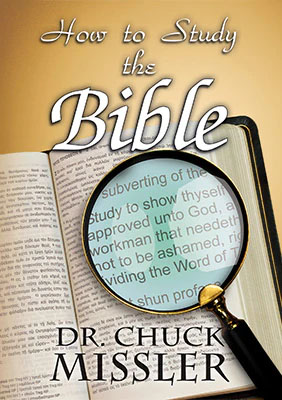
This was adapted from Chuck Missler’s book How to Study the Bible.
Also available in a two hour video presentation.
http://store.khouse.org
Notes:
1 Burgon, J. (1990). Unholy hands on the Bible (pp. C41-42) (J. Green, Ed.). Lafayette, Ind.: Sovereign Grace
Trust Fund.2 Ibid, p. C-42.
3 Kitchen, K. (1965). The Aramaic of Daniel. In D. J. Wiseman (Ed.), Notes on Some Problems in the Book
of Daniel (p. 79). London: The Tyndale Press.4 Kitchen, K. (1965). The Aramaic of Daniel. In D. J. Wiseman (Ed.), Notes on Some Problems in the Book
of Daniel (p. 77). London: The Tyndale Press.5 Matthew 24:15; 26:64; Mark 13:14, 26; Daniel 7:13-14; 9:27; 11:31; 12:11